
Maybe you already know about the importance of using warmups when you work out. However, what is their importance when working with students with disabilities?
Amy Sullivan-Caillouet, an Occupational Therapist, as well as our Lead Adaptive Dance Instructor in Adaptive Ballet and Adaptive Ballroom, shares some information with us.


MUSCLE TONE: The degree of tension or resistance in a muscle. In low muscle tone this is regarded as flaccid or floppy. Low muscle tone can contribute to hypermobility of the joints, as equal tension and resistance of opposing muscle groups is needed to keep a joint stable.
- Activities which develop strength and endurance will assist children with low muscle tone. Large movements and gross motor skill practise also assist the development of strength with fine motor activities.
- Fine motor activities (eg. drawing) can be adjusted to assist development of muscle tone eg. drawing up high on a blackboard encourages an anti-gravity position.
- Relay Races:
- – bunny hops and leap frog
- – animal walks e.g. bear walk, crab walk, monkey walk, giraffe walk, inch worm, eagle flap, duck waddle, snake slither,
- – jumping with a balloon/ball squeezed between knees
- – wheelbarrows
- – space hopper
- Wheelbarrows – Hold at knees until strong enough to hold at ankles. Aim to increase the number of steps/distance.
- Tug-o-War
- Walk – with a piece of elastic around ankles. Children have to keep elastic tight (ie. feet wide apart when walking) and try not to allow the elastic to fall off.
- Monkey Bars
- Sit Ups – with knees bent.
- Bridging – lying on back with knees bent up and feet flat on the floor. Encourage your child to lift his/her bottom up without it swaying. Keep a small gap between knees. Can they hold a bridge for an entire minute?
Body Scheme:
The internal awareness of one’s own body and the relationship of body parts to each other. Body scheme is dependant on sensory integration (proprioception, vestibular, visual systems) and perceptual skills eg. number skills, spatial relations.
Body Concept:
Intellectual knowledge of one’s body parts.
- Provide child with own mat to sit on during story time.
- Use activities to promote body scheme and concept on a regular basis within the home and school environment.
- Demonstrate as much as necessary and break instructions down into simple steps.
- Combine sensory input with language labels ie. link words with movement and position.
- Sausage Roll Game – Roll child up in a blanket to occlude his vision. Touch different body parts and have child name them.
- What Is Moving? – Blindfold child while lying on the ground. Move child’s arms and legs in, out, up or down and ask him to describe the movement eg. leg up.
- Sticky Numbers – Pick a number between 1 and 10. For chosen number (eg. 5) assume a position with 5 parts of body touching the ground (eg. 2 feet, 2 hands and head). Ask child to make a different body position with 5 parts touching the ground.
- Imitation Games – Stand in front of child and ask her to imitate you eg:
– touch different body parts with right and left hands
– touch different body parts with right and left hands.
– touch body parts with different body parts eg. ear to shoulder, elbow to knee.
– touch body parts with surroundings eg. shoulder to floor.
– mirror images where child is your reflection and must imitate all movements.
- Mime Activities – Act out stories, place names etc.
- Body Letters – Ask child to make her body into letters of the alphabet.
- Creative Dancing – Ask child to make her body long, short, large, small, jagged etc.
- Somersaults
- Obstacle Courses – Roll, crawl, jump, hop and climb through, over, under and around boxes, barrels, chairs, tables, ropes, blankets, ladders, tyre tubes etc.
- Trampolining
- Action Songs and Games:
– Hokey Pokey
– Pat a Cake
– “Heads,Shoulders, Knees and Toes…”
– Twister
– Simon Says
These are just some of the ways you can continue growth at home! Try them and let us know what were your favorites. Stay active, stay healthy, stay motivated.
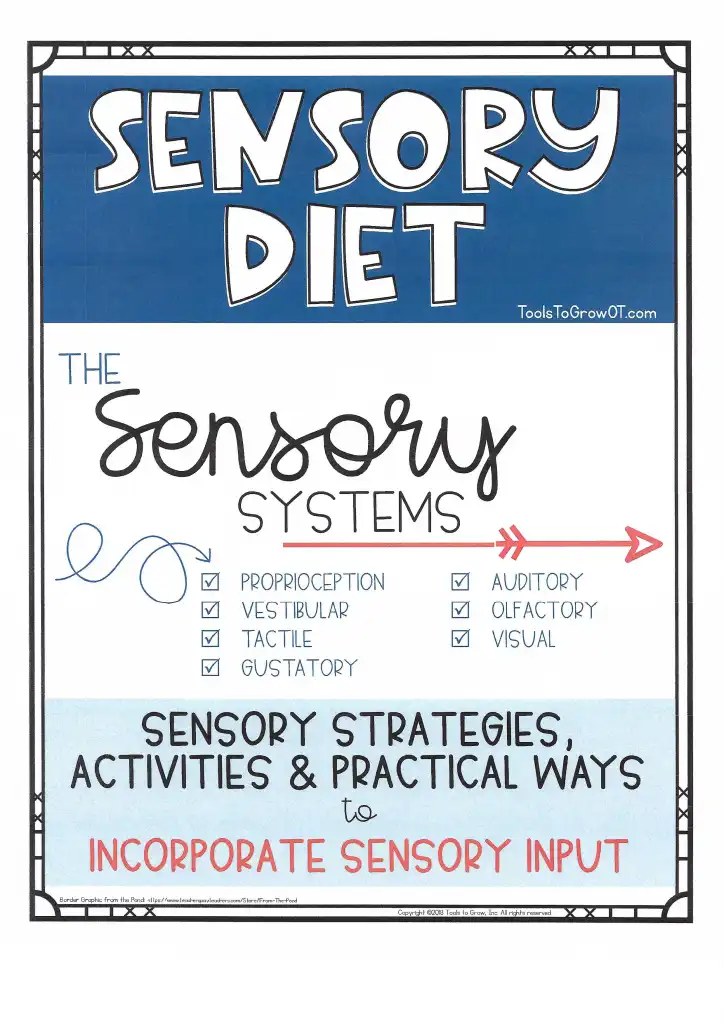
*Graphic from: http://www.ToolsToGrowOT.com1

 Jasmine's Beat®- An Adaptive Dance Company for Persons of All Abilities